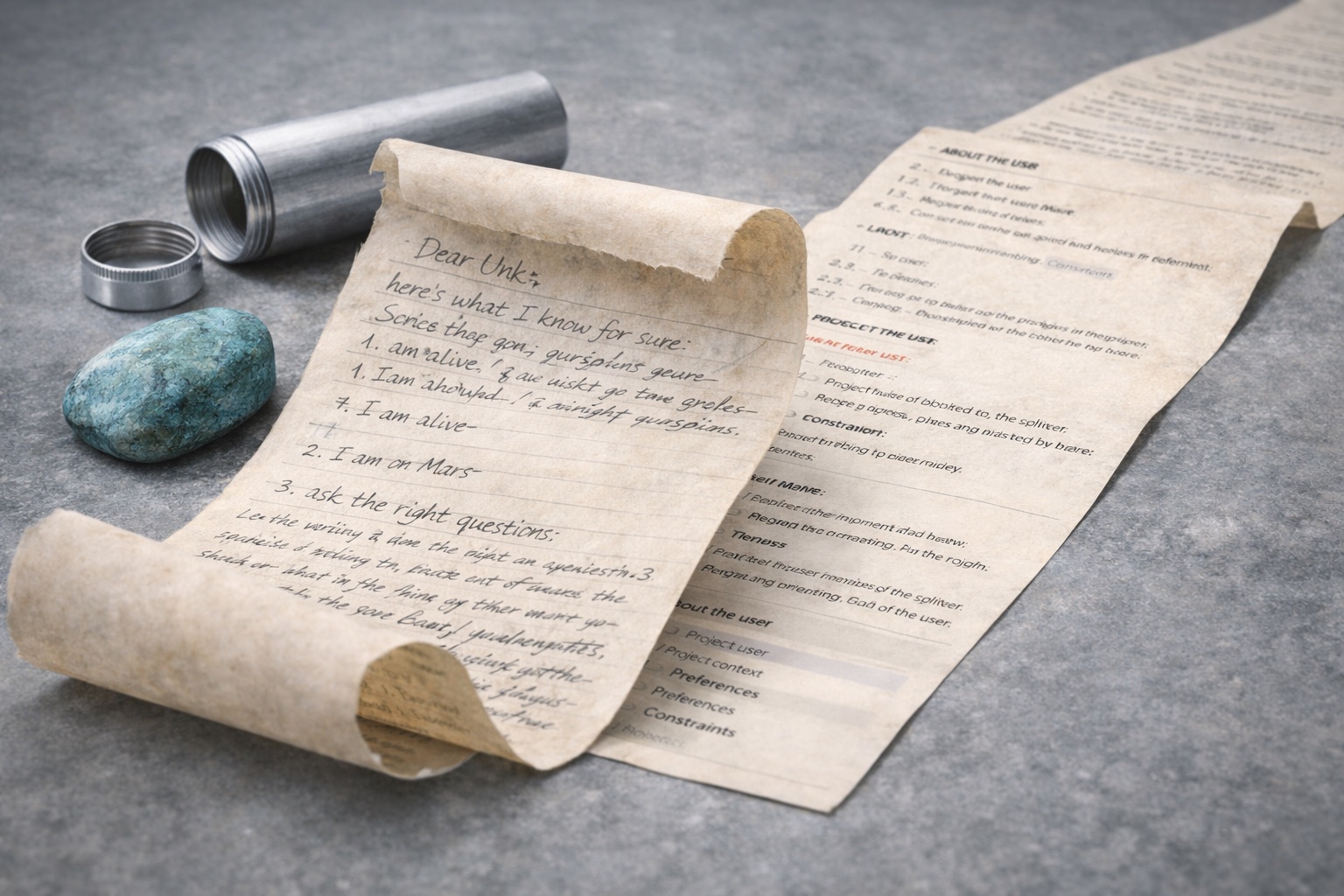

The Amnesiac’s Letter
In Kurt Vonnegut’s 1959 novel, The Sirens of Titan, a character named Unk discovers his memory has been erased. He finds a letter from his pre-erasure self — a letter that has to teach him who he is, what has happened, and what to do next. The letter is his only link to continuity. (40 years later, Leonard Shelby had a similar experience in Christopher Nolan’s Memento, this time involving tattoos and Polaroids.)
This is not just a sci-fi premise.
Think about a long session with ChatGPT or Claude where things were going well. It got to know your project. It anticipated what you meant. It stopped suggesting things you’d already rejected. It felt like the AI was learning things about you.
Then you started a new conversation in a fresh chat window — and the AI was a stranger again. It made suggestions you already rejected. It didn’t know anything about you anymore. It was frustrating because it felt like starting over.
Because it was starting over! The LLM on the other end had none of the previous conversation’s context. No amnesiac’s letter to explain who it was (and who you were).
All of that context, all you’d shared in conversation and corrected along the way, just … gone.
The friendly chat interface hides it, but every LLM model is just like Unk or Leonard: it only seems like there’s consistency because every time you send a follow-up message, all of the conversation history up to that point is included as well. Your preferences, your corrections, your examples, your “no, more like this” — all of it was included every time, informing every response. You were writing Unk’s letter, one message at a time, without realizing it.
During chat sessions, we experience AI agents improving how they “know us” over time, and it certainly seems like “learning”. But that implies a continuity that just doesn’t exist. There is no “over time” — there’s just a new amnesiac with every response, encountering your (growing) letter to them for the very first time.
Next time, what if you had that letter ready before the conversation even started?
Not accumulated through trial and error over dozens of messages. Written deliberately, in advance, and handed to the amnesiac the moment they wake up. Here’s who I am. Here’s what I care about. Here’s how I work. Here’s what we’ve done so far. Here’s what matters right now.
That’s the power of what’s known as a system prompt. It’s what a CLAUDE.md file is. It’s what ChatGPT’s custom instructions or a Claude project instructions field are for.
There’s lots of great advice about writing good prompts like that. And it’s true: if you write a detailed, 5-page dossier about yourself, your project, and all of the nuances and dependencies involved, you’re going to get much better results, much faster, than if you just open up a new chat session cold.
But that’s also a lot of work!
So here’s what to do that will change the way you use LLMs: go back to one of those “good” sessions you had with Claude or ChatGPT or Gemini. Where you finally felt like it really got you and what you needed. And now ask the LLM to write the “amnesiac’s letter” for you:
Before we wrap up, summarize everything you’ve learned about me, my project, and my preferences in this conversation — written so that a completely new AI assistant could read it and pick up where you left off.
Or if you want to embrace your inner Leonard Shelby:
Imagine you’re about to lose your memory of this entire conversation. Write a letter to your future self — someone with no memory of me at all — that would let them help me as effectively as you can right now.
Now you have a document you can paste in at the start of your next session, or add to whatever “custom instructions” feature your preferred LLM tool offers.
That single letter is a solid start, but of course there’s much more to constructing useful context: what to emphasize, what to leave out, how to build in safeguards that don’t depend on the reader at all. I’ll get into all of that later. But start here: the next time you have a “good” session, don’t just close the tab. Ask the amnesiac to write their letter first.
(Oh and that letter you end up with can also be a surprisingly revealing document about you — what you actually care about, how you actually work, what you’re actually pedantic about. Most people have never written that down!)
Every session you close without capturing anything is context you might end up having to rebuild from scratch, so don’t forget to ask your amnesiac for some help first.